
While this guide and the following charts are here to help you learn about the 4 Cs, we are also available to help you directly. Our staff GIA Graduate Gemologists are here to help you at every stage—whether you are looking to buy today or in six months.
What Are the 4 Cs of Diamonds?
Created by the Gemological Institute of America (GIA) in the 1940s and 1950s, the 4 Cs—Cut, Color, Clarity, and Carat Weight—form the universal standard for assessing diamond quality, value, and visual beauty. Before this system existed, jewelers used inconsistent terms that made it difficult for buyers to compare stones or understand true quality. Today, understanding the 4 Cs empowers you to evaluate any diamond with confidence, balance your aesthetic preferences, and maximize your budget.
1. Cut
Refers to the precision of a diamond's facet angles and proportions. Cut dictates how brilliantly a diamond reflects light and produces sparkle.
2. Color
Measures the absence of color in a white diamond, graded on a scale from D (Colorless) to Z (Light Yellow or Brown tint).
3. Clarity
Evaluates the presence of internal characteristics (inclusions) and surface imperfections (blemishes) under 10x magnification.
4. Carat Weight
Measures a diamond's total physical mass. One metric carat equals 0.20 grams (or 100 individual points).
Diamond Cut
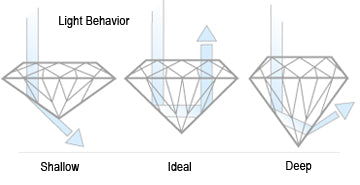
Although terms like "princess cut" and "cushion cut" describe a diamond's shape, Cut actually refers to the angling of a diamond's facets. A well-cut diamond ideally reflects light to bring maximum brilliance and fire to the stone.
Because sparkle is the most important part of a diamond's appearance, this is arguably the most vital of the 4 Cs. A high-quality diamond that is poorly cut will appear dull, while a diamond with slightly lower color or clarity can look spectacular if cut to ideal proportions.
Sparkle is everything. It is always better to have a slightly smaller "Ideal" or "Excellent" cut diamond than a larger "Good" or "Fair" cut diamond that appears dull.
Diamond Color
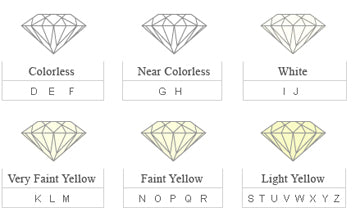
Diamonds are graded from D (Colorless) to Z (Light Yellow). Because of our high quality standards, deBebians only carries diamonds graded D through J.
- D-F: Colorless (Rare and carry a higher price premium)
- G-H: Near Colorless (Face up white, an excellent balance of value and look)
- I-J: Near Colorless (Slight warm tint, very budget-friendly)
Fluorescence: This natural phenomenon can benefit diamonds in the I-J range by masking yellow tints, making the stone appear whiter than its grade suggests.
If you are setting your diamond in Yellow Gold or Rose Gold, you can safely choose an "I" or "J" color stone. The metal's natural color hides the diamond's slight warmth.
Diamond Clarity
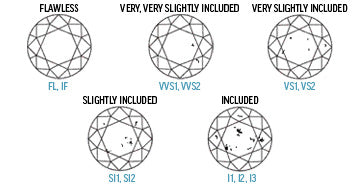
Clarity measures the internal inclusions and external blemishes. We only sell loose diamonds that meet GIA/AGS standards, from IF to SI2.
| FL / IF | Flawless / Internally Flawless. No inclusions visible under 10x magnification. Extremely rare and valuable. |
| VVS1 / VVS2 | Very, Very Slightly Included. Inclusions are very difficult for even a trained grader to see under 10x. |
| VS1 / VS2 | Very Slightly Included. Inclusions are typically "Eye-Clean" (invisible to the naked eye). Excellent balance of purity and price. |
| SI1 / SI2 | Slightly Included. Inclusions visible under 10x. Many SI1s are eye-clean, offering the best price-to-size ratio. |
Seek "Eye-Clean" SI1 or VS2 diamonds. They look identical to Flawless diamonds to the naked eye under normal viewing conditions but cost significantly less.
Diamond Carat Weight
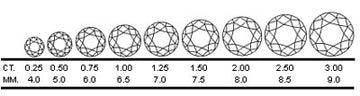
Carat is the measure of a diamond's weight, not necessarily its physical dimensions. 1 carat is divided into 100 points (e.g., a 0.50ct diamond is 50 points).
A diamond's cut determines how much of that weight is "face-up" size versus hidden in the depth. Because large diamonds are rarer, the price per carat increases significantly at full carat weights (e.g., jumping from 0.99ct to 1.00ct).
To save money, look for "under-size" diamonds. Buying a 0.90ct or 0.95ct diamond instead of a full 1.00ct can save you a large percentage while appearing almost identical in size.
Understanding Diamond Anatomy & Light Performance
To truly evaluate a diamond's cut, it helps to understand its physical geometry. How light travels through a diamond depends entirely on the mathematical proportions between its key anatomical parts:
Table
The flat, top horizontal facet of the diamond. The table percentage relative to the stone's width plays a major role in light entry and return.
Crown
The upper portion of the stone extending from the girdle up to the table. The crown angle dictates how incoming light refracts into colored flashes (Fire).
Pavilion
The bottom cone-shaped section of the diamond that reflects light back through the top. If too deep or too shallow, light leaks out the bottom, creating dead zones.
Girdle & Culet
The girdle is the outer edge where crown and pavilion meet. The culet is the tiny facet at the bottom point (an ideal culet is 'None' or 'Very Small' to avoid light leakage).
The 3 Elements of Diamond Sparkle
- Brilliance: The bright white internal and external light reflected straight back to your eye.
- Fire: The dispersion of white light into bright spectral colors of the rainbow.
- Scintillation: The intense flashes of light and shadow produced as the diamond, light source, or wearer moves.
The 'Fifth C': Diamond Certification & Lab Grading Reports
While the 4 Cs outline a diamond's physical traits, an independent grading certificate acts as its official identity document. Never purchase a diamond without an unbiased, third-party grading report from an accredited gemological laboratory.
The Gemological Institute of America (GIA) is the global gold standard for natural diamonds, enforcing the strictest grading criteria. For lab-grown diamonds, reports from the International Gemological Institute (IGI) or GIA offer trusted, verifiable accuracy.
Natural vs. Lab-Grown Diamonds: Evaluating Your Options
When selecting a center stone, you have the choice between mined natural diamonds and advanced lab-grown diamonds. Both share identical chemical, physical, and optical characteristics (carbon crystal lattice, 10 on the Mohs hardness scale).
| Feature | Natural Mined Diamonds | Lab-Grown Diamonds |
|---|---|---|
| Origin | Formed miles under the Earth's crust over 1 to 3 billion years. | Created in high-tech laboratories replicating Earth's heat and pressure (CVD / HPHT). |
| Composition | Pure crystalline carbon (10/10 Mohs Hardness). | Pure crystalline carbon (10/10 Mohs Hardness). |
| Value & Price | Rarer supply; commands a higher market price and long-term value retention. | Offers 70–80% cost savings compared to natural stones of identical 4 C grades. |
| Visual Appearance | Identical brilliance, fire, and durability. | Identical brilliance, fire, and durability. Unindistinguishable to the naked eye. |
Frequently Asked Questions About the 4 Cs
Which of the 4 Cs is the most important?
Cut is generally considered the most important of the 4 Cs because it determines how much a diamond will sparkle. A poorly cut diamond will look dull even if it has perfect color and clarity.
What does 'Eye-Clean' mean in diamond clarity?
An Eye-Clean diamond is one where inclusions cannot be seen by the naked eye when viewed from the top under normal light conditions. This usually applies to diamonds in the VS1 to SI1 ranges.
Is a 1 carat diamond always the same size?
No. Carat is a measure of weight. Depending on how a diamond is cut (shallow vs. deep), two diamonds of the same carat weight can have different surface areas and look different in face-up size.
Why is independent certification important when buying a diamond?
An independent grading certificate from accredited labs like the GIA or IGI guarantees that the diamond's color, clarity, carat weight, and cut proportions have been evaluated objectively without retail markup bias.
Are lab-grown diamonds real diamonds?
Yes. Lab-grown diamonds are optically, physically, and chemically identical to natural diamonds. They consist of pure carbon organized in a 3D diamond crystal lattice and display identical brilliance, fire, and hardness.
What are the ideal depth and table percentages for a round diamond?
For a Round Brilliant cut diamond, an Ideal/Excellent cut generally has a Table Percentage between 54% and 59% and a Depth Percentage between 59.5% and 62.5%.
What is diamond fluorescence and does it affect diamond quality?
Fluorescence is the soft glow (usually blue) that some diamonds emit under ultraviolet (UV) light. Faint to Medium fluorescence rarely affects visual appearance. In fact, blue fluorescence can make lower-color diamonds (I-J) face up looking whiter. Strong or Very Strong fluorescence can occasionally make a stone look milky, so expert review is recommended.
How can I prioritize the 4 Cs when shopping on a strict budget?
To maximize visual beauty on a budget: 1) Prioritize Cut Grade (Ideal/Excellent) for maximum sparkle; 2) Drop Color to G, H, or I (which still looks white once set); 3) Choose an Eye-Clean SI1 or VS2 Clarity; and 4) Buy 'Under-Weight' carat sizes (like 0.90ct or 1.90ct) to avoid steep price jumps at whole carat marks.
Do Fancy Shape diamonds (Ovals, Pears, Emeralds) follow the same 4 Cs rules?
Yes, but with slight nuances. GIA does not assign an overall Cut grade to fancy shapes (like oval or emerald cuts) on certs due to varying length-to-width preferences. Also, step-cut shapes like Emerald and Asscher cuts expose inclusions more easily, so higher clarity (VS2 or better) is recommended.
Can a lower carat weight diamond look bigger than a higher carat diamond?
Yes. If a higher-carat diamond is cut too deep, much of its weight is hidden in the bottom pavilion rather than the top surface area. A well-proportioned 0.90-carat diamond cut to ideal measurements can have a larger millimeter footprint than a deeply cut 1.00-carat stone.
How do I know if an SI1 or SI2 clarity diamond is 'Eye-Clean'?
An eye-clean diamond has inclusions that are small, dispersed, or light-colored, making them invisible without magnification. At deBebians, our GIA Graduate Gemologists personally inspect SI1 and SI2 stones under professional lighting to confirm whether inclusions are visible to the naked eye before purchase.
What is the best way to clean and care for a diamond ring at home?
Clean your diamond regularly by soaking it in a bowl of warm water mixed with mild dish soap for 15-20 minutes. Gently scrub behind the stone and setting with a soft-bristled toothbrush, rinse thoroughly under warm water, and dry with a lint-free microfiber cloth.